The Working Genius Team Map: A Signal Your Team Can Read
The short version
A Working Genius team map puts every person's results on one page, so a leader can see where the team has real energy, where it has a gap, and who is carrying work that drains them. It is a real deliverable, the same one page artifact a client receives with their own data on it. Read it well and vague complaints turn into visible structure: ideas that never ship, decisions nobody scrutinized, one person holding all the momentum. Most of what it exposes is fixable with pairings and handoffs rather than headcount.
An individual result is interesting. The map is where a leader earns their money. Lay every profile side by side and the model stops being a model. It becomes a picture of your organization, and the patterns on it are usually the problems you have been describing in vaguer language for years.
What a Team Map Shows
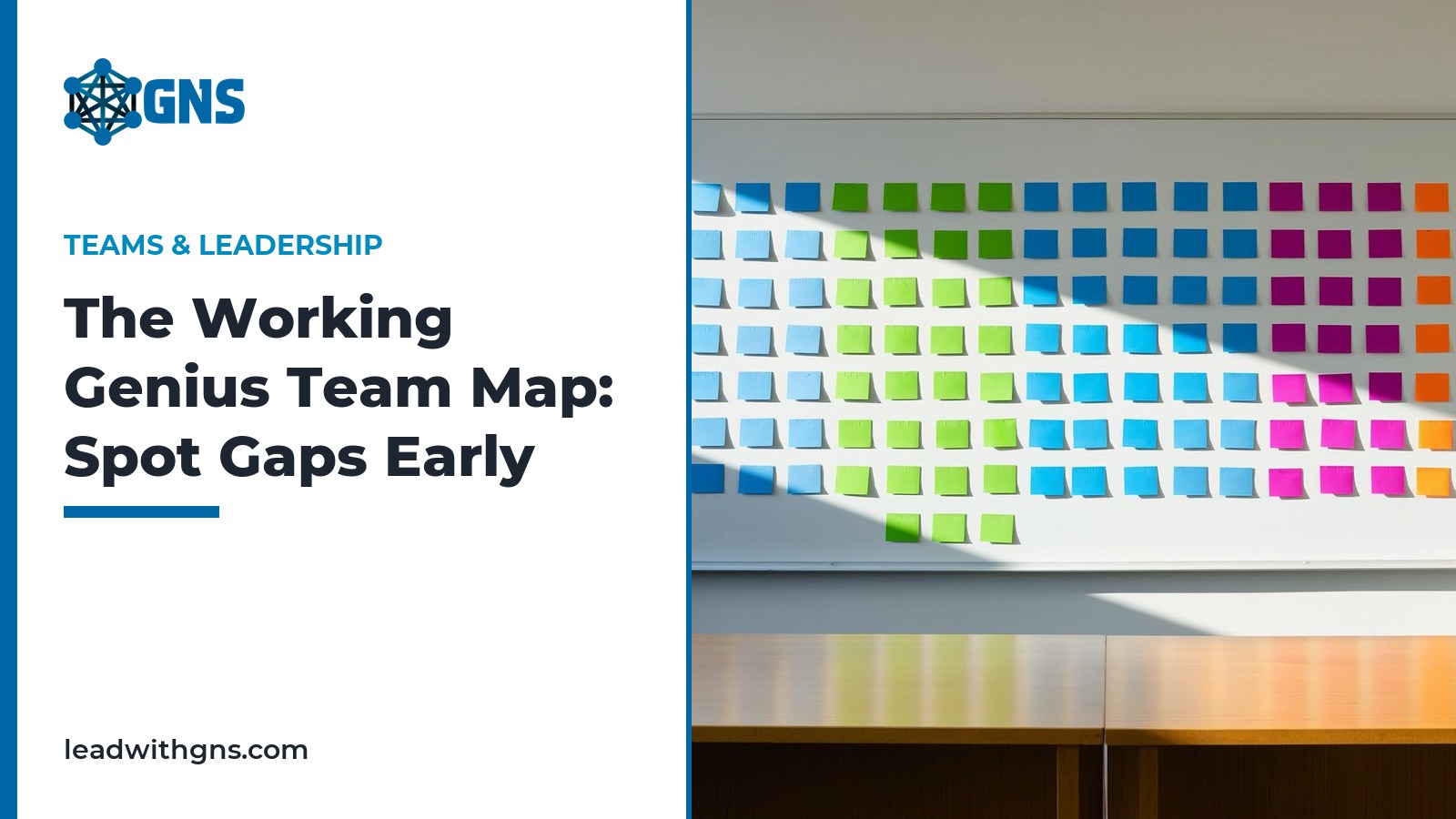
The map gathers each person’s two Geniuses, two Competencies, and two Frustrations across the six types: Wonder, Invention, Discernment, Galvanizing, Enablement, and Tenacity. (New to the six? Start with our complete guide.) Because those types run in the order work actually travels, from raising the question to finishing the thing, the map shows whether your team has energy at every stage or is quietly short at one.
It is one page, and it is the same artifact every client receives. Ours is published with our real data on it, on the About page.
Think about it the way an operator thinks about red, yellow, and green. A status board works because everybody reads it the same way from across the room, no meeting required. Most organizations built that signal for the process and never built it for the people running it. The map is that signal, for people.
The Patterns That Predict Problems
After mapping teams across the Twin Cities and Western Wisconsin, the same handful comes up again and again:
| Map Pattern | What It Looks Like Day to Day |
|---|---|
| Plenty of Invention, little Tenacity | Great kickoffs, stale projects, a drawer full of version one drafts |
| No Discernment among the deciders | Ideas go straight from the whiteboard to the budget, and the misses are expensive |
| One person holds all the Galvanizing | Everything moves when they push and stops the week they take vacation |
| Heavy Enablement, light Wonder and Invention | A loyal, helpful team running yesterday’s playbook and rarely questioning it |
| A leader working in their Frustrations | Slow burnout at the top, read as overwork when it is misalignment |
None of these are character flaws. They are structural, and a structure you can see is a structure you can change.
Fixing Gaps Without Hiring
The first reaction to a gap is usually “we need to hire for that.” Sometimes. Usually there is something faster:
- Borrow the genius. Somebody elsewhere in the organization has exactly what your team is short on. Pull them into the right meeting at the right stage.
- Shrink the gap work and rotate it. When a stage sits in everybody’s Competency or Frustration, schedule it on purpose, keep the doses short, and pass it around so no one person drowns in it.
- Redesign the handoffs. Most execution problems are handoff problems. Nobody owns the moment an idea needs scrutiny, or the moment a decision needs momentum. Naming the owner of a stage fixes more than reorganizing a department, and pairing a visionary with an integrator is the most valuable version.
This is also where the thing everybody has been driving around finally gets named. It is rarely a difficult person. It is a stage of work with nobody in it, or one person’s genius parked in a lane it was never built for. Powerful, and in the wrong crossing. Name it and it can be moved, and what blocked every lane becomes the strongest thing you own.
When to Remap
The map is a snapshot of a roster, so remap when the roster changes: a key hire, a departure, two teams merging, real growth. Individual results tend to hold. The combination is what decides how work flows, and it changes every time the team does. That is why our approach treats mapping as an ongoing practice rather than a one time event.
The Bottom Line
A team map turns vague complaints (“we never finish anything,” “everything depends on Sarah,” “we keep launching duds”) into visible structure you can fix with pairings, handoffs, and role changes, often without hiring anybody. If you can describe a chronic problem, the map can usually show you where it lives.
Want to see yours? Schedule a free consultation and we will walk you through how a mapping session runs.
Frequently Asked Questions
What is a Working Genius team map?
It is one page showing every team member's Geniuses, Competencies, and Frustrations laid out across the six types. That single view is what makes structural gaps visible, because you can see at a glance which stage of work the team has energy for and which stage it is quietly missing.
What if our team map shows a gap we cannot hire for?
Most teams cannot hire their way out of a gap, and most do not need to. You can borrow the genius from elsewhere in the organization, schedule the gap work deliberately in short rotations, or redesign the handoff so that stage gets explicit attention and an owner.
Do individual results change over time?
The Table Group describes Working Genius as quite stable, because it reflects how a person is wired to contribute rather than their skills or their mood. What does change is the team around them, which is why remapping after turnover or growth is worth doing.
Can a small team of two or three people use a team map?
Yes, and small teams often get the most out of it. When there are only three of you, each person necessarily covers more of the six types, and knowing exactly which stages drain which person is what makes the workload conversation honest.