Blog
Naming the Thing Everyone Works Around
Writing on the conversations teams avoid, what the avoidance actually costs, and how a shared language gets the next one started.
More Writing
Hiring and Role Design With Working Genius: Name the Work First
Most job descriptions list skills and experience and never name the kind of work the seat actually demands every day. Working Genius fixes that: describe the role across the six types of work, compare it to your team map, then place or hire somebody whose energy matches the seat. Done in that order, a six month surprise turns into a fifteen minute conversation up front. A frustration is not a weakness, it is a genius standing in the wrong intersection, and role design is how you move it.

Leadership Coaching in Hudson, WI, Built Around How You Work
GNS coaches leaders one on one from its home base in Hudson, Wisconsin, across the St. Croix Valley, the Twin Cities East Metro and Western Wisconsin. Coaching starts with the Working Genius assessment, then moves straight to what you do with the results: your role, your calendar, your team, your energy. The first conversation is thirty minutes and costs nothing.

Team Building Workshops in the Twin Cities That Outlast Monday
Most team building produces a good afternoon, not a better team. A Working Genius workshop is different because it leaves three things behind: a profile for every person, a map of the whole team, and specific changes to how work gets assigned and handed off. GNS facilitates those workshops for organizations across the Minneapolis-St. Paul metro and Western Wisconsin.

Team Development for Nonprofits in Western Wisconsin
Small organizations cannot absorb misalignment. On a team of six where everyone wears three hats, one person stuck in their frustration zone slows half the operation. GNS brings Working Genius team development to nonprofits and small businesses across Western Wisconsin from its home base in Hudson, so small teams can hand out the hats by energy instead of by habit.

The Visionary and the Integrator: Build the Pairing on Purpose
A growing organization needs both big thinking and disciplined delivery, and those two almost never sit at full strength in one person. Pairing a visionary, strong in Wonder and Invention, with an integrator who carries decision and follow through turns ideas into finished work without draining either one. The pairing rarely forms on its own. A Working Genius team map shows you the gap between the two, so you can build the handoff on purpose instead of hoping for it.
What Is the Working Genius Assessment? A Leader's Guide
The Working Genius assessment takes about fifteen minutes. Built by Patrick Lencioni and The Table Group, it measures how people contribute to getting work done: two types of work that give you energy, two you can do but that wear on you, and two that drain you. Personality tells you who is in the room. This tells you where the work stalls.

What to Expect From a Working Genius Debrief With GNS
A Working Genius debrief is a guided conversation about your assessment results: what your two geniuses, two competencies, and two frustrations mean inside the job you actually hold. With GNS it is personal and practical. You leave with language for how you work best, a clear read on which parts of your week give energy and which take it, and next steps you can use the same week.

Why Good Employees Burn Out on a Reasonable Workload
Your most reliable people can burn out on a normal schedule, because the hours were never the whole story. The Working Genius model separates the work that gives a person energy from the work that quietly takes it, and months in the draining kind produce burnout symptoms at a perfectly ordinary forty five hours a week. Leaders who map their team can see that misalignment while it is still a scheduling problem. Left alone, it becomes a resignation letter.
The Working Genius Team Map: A Signal Your Team Can Read
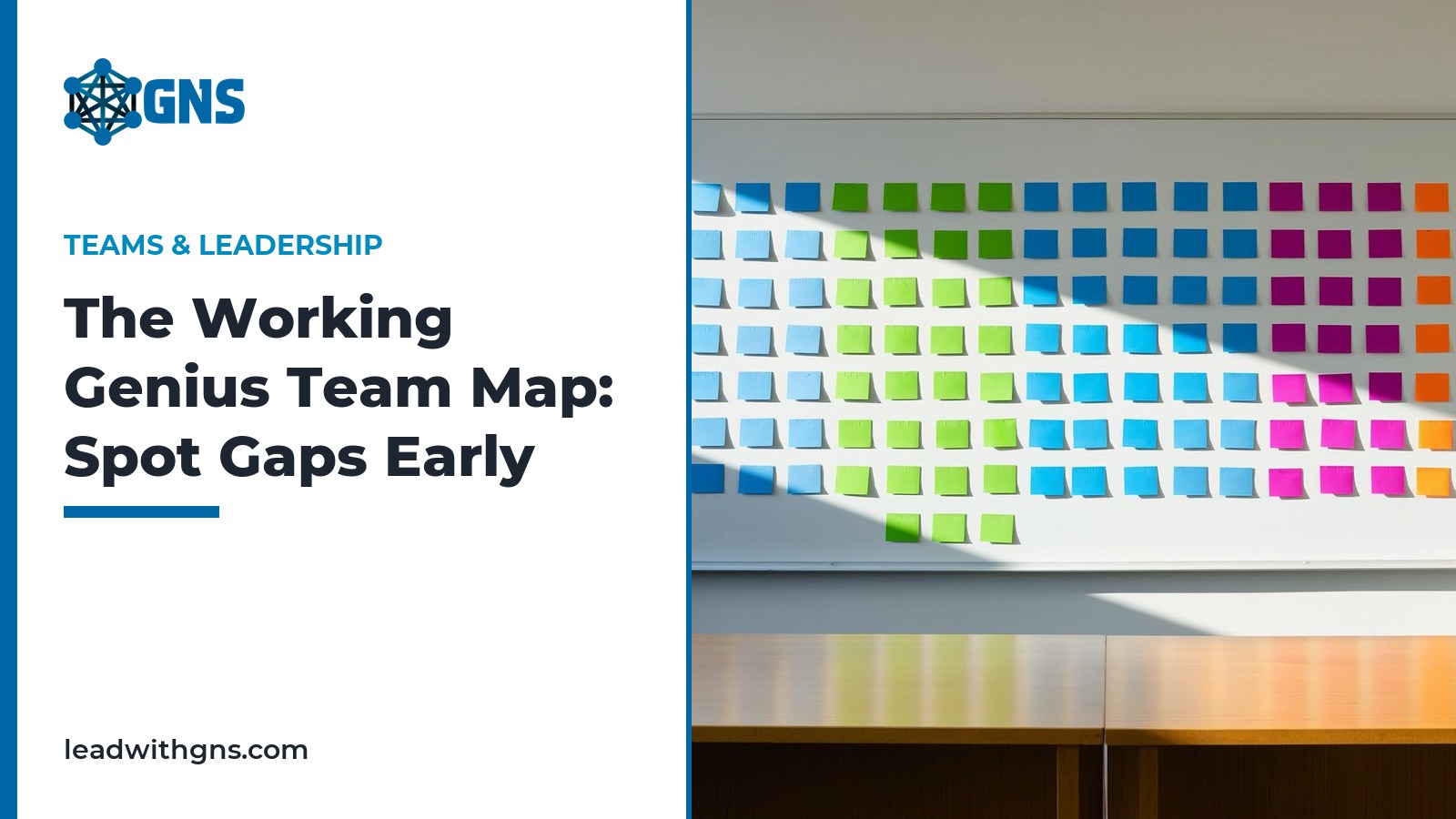
A Working Genius team map puts every person's results on one page, so a leader can see where the team has real energy, where it has a gap, and who is carrying work that drains them. It is a real deliverable, the same one page artifact a client receives with their own data on it. Read it well and vague complaints turn into visible structure: ideas that never ship, decisions nobody scrutinized, one person holding all the momentum. Most of what it exposes is fixable with pairings and handoffs rather than headcount.
Reading About It Is the Cheap Part
Thirty minutes, free, and you do not need anything figured out first.